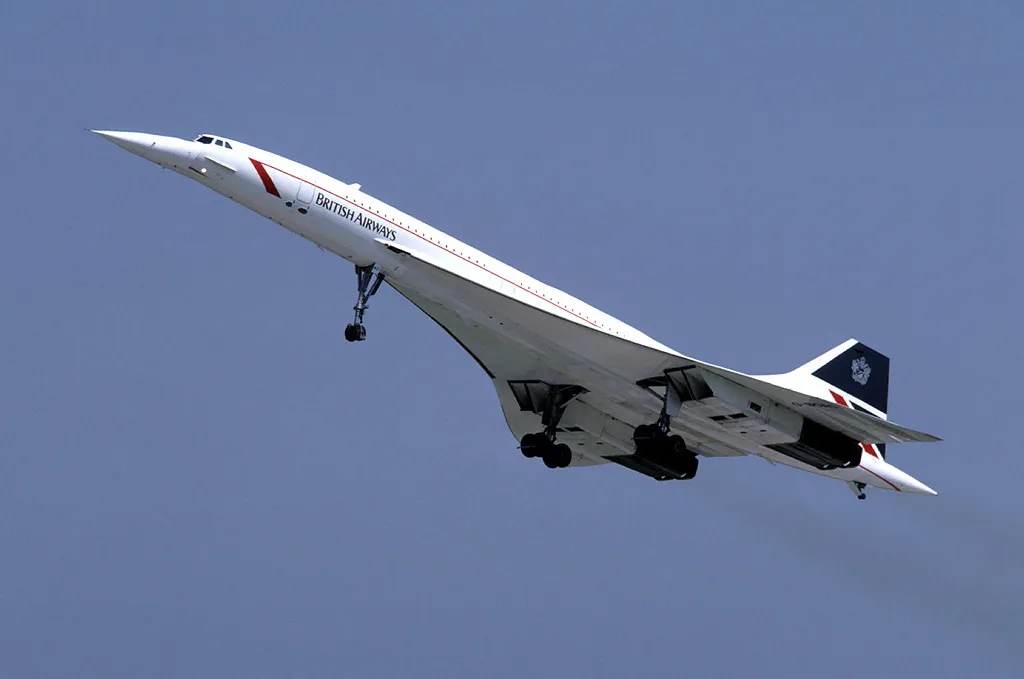
Concorde is a supersonic passenger airliner built jointly by Aérospatiale of France and the British Aircraft Corporation of the UK under an Anglo-French treaty. It was designed to carry passengers across the Atlantic at more than twice the speed of a conventional jet, and it is one of only two supersonic airliners to have carried fare-paying passengers. Only Air France and British Airways flew it in scheduled service, mainly on transatlantic routes between Europe and North America.
Design and development
The project grew out of parallel British and French studies for a supersonic transport, which the two governments merged into a single treaty-backed programme rather than compete against each other. The prototype first flew on 2 March 1969, and development continued through the early 1970s as the aircraft was tested for certification and refined for airline service. The programme was expensive and politically fraught: rising costs, environmental objections to sonic booms over land, and the 1970s oil crisis all weighed on its commercial prospects, and in the end only 20 aircraft were built: 6 prototype and development airframes plus 14 production aircraft, 7 for Air France and 7 for British Airways. No other airline bought the type.
Specifications
Concorde is 61.66 metres long with a wingspan of 25.56 metres, a slender delta-wing shape built for supersonic flight rather than cabin volume. Its maximum take-off weight is 185,065 kg. The type is powered by four Rolls-Royce/Snecma Olympus 593 turbojets with reheat, which let it cruise at about 2,150 km/h, or Mach 2.02 — roughly twice the speed of a typical subsonic airliner. Its range is about 6,580 km, and in a typical airline configuration it seated 100 passengers, though the type was certified for up to 128 in a denser layout.
The cost of building one reflected the scale of the engineering effort: Air France and British Airways paid about US$20 million per aircraft at 1976 prices.
Variants
Concorde flew in essentially one production configuration once certified; the differences between airframes were mainly between the early pre-production prototypes used for testing and the production aircraft delivered to the two launch airlines. No stretched, shortened or re-engined passenger version was ever built or sold.
Operators and service
Scheduled supersonic services began in 1976 and continued for 27 years, flown only by Air France and British Airways, the two airlines of the governments that funded its development. British Airways’ best-known route linked London with New York, cutting a flight of around eight hours on a subsonic jet to about three and a half hours. The type’s commercial life ended after the 2000 Air France crash near Paris dented passenger confidence, and rising maintenance costs made the ageing fleet harder to justify. Concorde was retired from commercial service on 24 October 2003, with the last ferry flight following on 26 November 2003.
Safety record
Concorde’s most serious accident was the crash of an Air France aircraft shortly after takeoff from Paris–Charles de Gaulle on 25 July 2000, which killed all on board and four people on the ground; the aircraft struck debris from a ruptured tyre that punctured a fuel tank. That accident, reported by Wikipedia as a central factor in the type’s declining passenger numbers, preceded its retirement by three years.
Similar aircraft
- Tupolev Tu-144: the Soviet supersonic airliner and Concorde’s only rival to carry passengers, developed in the same era but withdrawn from passenger service much earlier.
- Boeing 747-8: a large subsonic airliner from the same generation of long-haul jets, representing the conventional alternative Concorde was built to beat on speed rather than capacity.